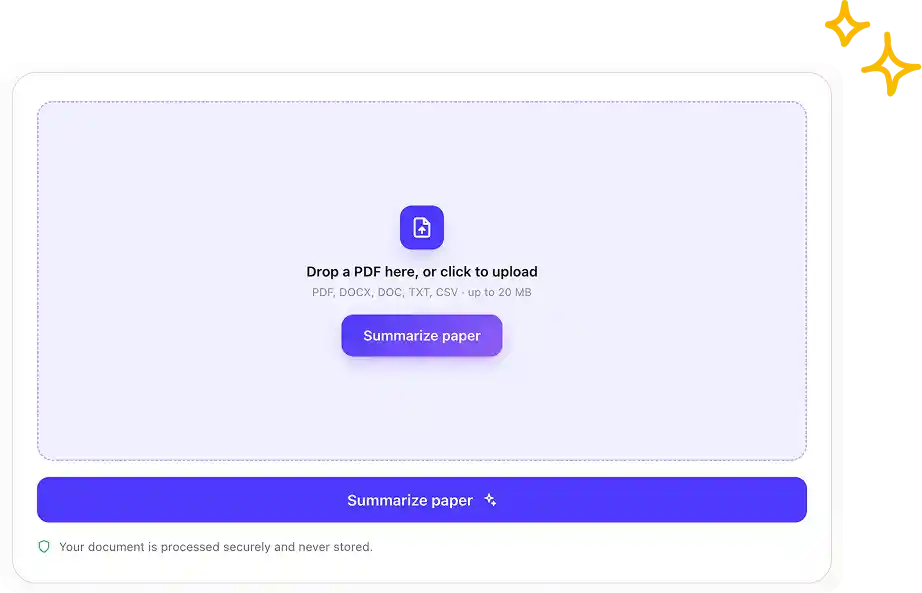
Drop your paper as a PDF, DOCX, TXT, or CSV, and our research paper summarizer provides a structured summary of the key points and main ideas in under a minute.
Understand long papers without reading them in their entirety — our AI assistant extracts the most important ideas, allowing you to grasp scientific research documents in seconds instead of hours.
Drop your own photo into the meme maker or choose from classic meme templates — Drake, Distracted Boyfriend, Doge, Pepe, Galaxy Brain, Two Buttons. PNG, JPG, HEIC, and WebP all work, including iPhone photos.
Paste the paper URL or upload the PDF — “summarize arXiv:2410.21276,” “TL;DR this 40-page Nature paper,” “extract the methodology from this DOI.” The AI Research Paper Summarizer parses the structure of the academic paper and writes the summary in the format you asked for.
Get a high-resolution meme in seconds — no watermark. Post it to Instagram, TikTok, Reddit, X, or drop it in the group chat. Don't like the caption? Generate a fresh variation with one click.
USE CASES
Feed the AI Research Paper Summarizer a stack of PDFs and get structured summaries with key findings, methodology and limitations for each — turning a week of reading into an afternoon. Compare claims across papers without re-opening every PDF.
Upload PDF or DOCX from your laptop, or paste an arXiv abstract URL, a DOI, a Nature / Science / ACM landing page — the AI Research Paper Summarizer pulls the full paper and summarizes it. Works with scanned PDFs too (OCR built-in).
Get a clean breakdown that mirrors the academic paper structure: abstract, introduction, related work, methodology, results, discussion, limitations and conclusion — the way SciSpace and Scholarcy do it, but with sharper, more readable summaries.
Upload a batch of related papers and the AI Research Paper Summarizer cross-references them — same datasets, same benchmarks, contradicting results, citation lineage. Perfect for systematic reviews, meta-analyses or just figuring out which paper to read first.
Drop in the assigned reading and get back a one-page summary plus the 8–10 must-know terms and concepts for the seminar. Optional flashcard mode generates Q&A pairs you can drill before the exam — turning a 30-page research paper into an hour of useful study.
After the summary, keep asking. “What was the sample size?” “Explain equation 3 like I'm in grad school, not a postdoc.” “What would a critical reviewer attack here?” Every answer cites the page or section of the research paper it came from, so you can fact-check before you cite it.
Drop in a PDF or paste an arXiv link — the AI Research Paper Summarizer reads it end-to-end and gives you a clean summary in under a minute. Free to try, no signup.
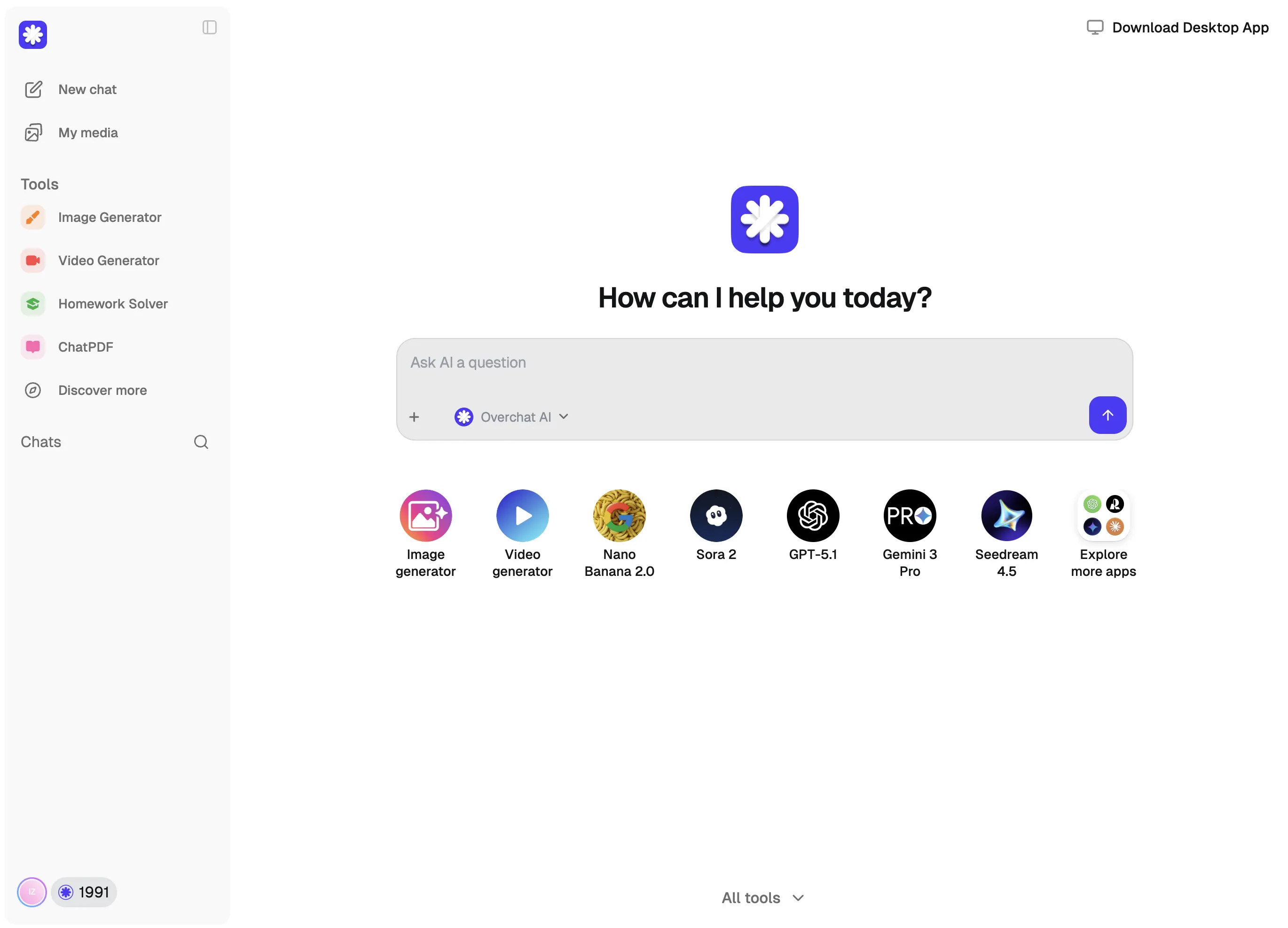
Overchat AI brings you the power of the world's top AI models: ChatGPT, Claude, Gemini, Mistral, and more.
An AI Research Paper Summarizer is an online tool that uses natural language processing to read an academic paper end-to-end and produce a concise, structured summary — abstract, methodology, key findings, limitations and conclusion. The Overchat AI Research Paper Summarizer works on PDFs, DOCX, arXiv links and journal URLs, including long papers with math, figures, tables and dense references.
Drop the PDF, DOCX or arXiv link into the Overchat AI Research Paper Summarizer, pick the summary depth (TL;DR, section-by-section or literature-review-grade), and the AI returns a structured summary in under a minute. After that you can ask follow-up questions in chat — “what dataset did they use?”, “explain equation 4”, “compare results with Smith et al. 2024” — with every answer cited to the page of the paper.
In 2026 the leading AI research paper summarizers include Overchat AI Research Paper Summarizer, SciSpace, SciSummary, Scholarcy, Paperguide, NoteGPT and Anara. Overchat AI stands out because it summarizes any academic paper with frontier models (GPT-5, Claude Opus 4.8, Gemini 3 Pro), supports PDF / DOCX / arXiv / DOI in the same flow, and lets you chat with the paper for follow-up questions — not just a one-shot summary.
PDF, DOCX, DOC, TXT and scanned PDFs (built-in OCR handle math, figures and tables in scans). You can also paste an arXiv abstract URL, a DOI, or a journal landing page (Nature, Science, ACM, IEEE, PubMed, SSRN) and the AI Research Paper Summarizer pulls the full text and summarizes it — no manual download required.
Two stages. First the paper is parsed: the AI Research Paper Summarizer detects the structure of the academic paper — abstract, introduction, methodology, results, discussion, references — and chunks it into semantically meaningful blocks. Then a large language model performs abstractive summarization on each block and stitches the outputs into a coherent summary, focusing on findings, methods and limitations rather than restating background.
Frontier-model summarizers reproduce the main claims, methods and headline results of a research paper with very high fidelity — high enough to triage what to read in full. They are NOT a substitute for reading critical sections (proofs, ablation tables, exact numerical results), so the Overchat AI Research Paper Summarizer cites every claim back to the page or section, making it easy to verify before you cite the paper in your own work.
Yes. The Overchat AI Research Paper Summarizer does not train on user uploads and does not share uploaded papers with third parties. Files are processed for the summarization request only and then removed from disk. For pre-print drafts, manuscripts under review and confidential lab work, this means you can run summaries without exposing the paper to the open web — unlike browser-extension tools that send the page through public endpoints.
Use the AI Research Paper Summarizer to triage, organize and understand papers, but cite the underlying research paper directly — never cite the summary as your source. Most universities and journals treat AI summaries as research aids, similar to a search engine or reference manager: fine for orientation, not acceptable as a primary citation. The Overchat AI Research Paper Summarizer makes this easy by linking every claim back to the page in the original paper.
Chinese company Baidu has quietly released a model that's just as good as DeepSeek and ChatGPT — ERNIE 4.5 delivers exceptional performance at a fraction of the cost — and most people outside China have never even heard of it.

If you're wondering: what is DeepSeek AI, the answer is quite simple. DeepSeek AI is a Chinese AI research lab that builds large language models. The company released several models in late 2024 and early 2025 that compete directly with OpenAI's GPT-4 and Anthropic's Claude, but at a fraction of the operating cost.
ChatGPT Plus costs $20 per month plus tax, while the Pro plan costs $200 per month plus tax. Understandably, not everyone is willing to pay that much for a chatbot, especially if the premium features aren’t worth it to them. This raises an obvious question: how can I use ChatGPT for free?
Available on Web, iOS, and Android. Access your AI assistant anywhere, anytime.




.svg)
