
.svg)





What is Claude Opus 4.6?
Claude Opus 4.6 is the most capable AI model from Anthropic, released in February 2026. It's part of the Claude model family — a series of AI models optimized for coding and agentic work. AI models from the Claude family are among the most widely used in the enterprise agentic workflow world. Overchat AI is making this powerful capability accessible to ordinary people through our all-in-one AI platform.
Anthropic, the company behind Claude, was founded in 2021 by former OpenAI researchers Dario and Daniela Amodei. It focuses on AI safety and building AI systems that work reliably on scale, are secure, safe, and trustworthy.
Claude Opus 4.6 is one of the best AI mocels Anthropic has ever released, exceling at coding, creative writing, math, legal work, and deep research. It's competitors include Google Gemini 3 Pro and GPT 5-3 Codex.
Claude Opus 4.6 Features
1 million token context window. This is the largest context window in the Claude family of models and a 5x increase from the previous figure of 200,000. The Opus model was already one of the smartest when it came to context optimization, but with this feature, it can handle enormous information loads without forgetting important details or losing focus.
Compared to its predecessor Claude Opus 4.5, the new version shows stronger reasoning, better factual accuracy, and noticeably improved writing quality.
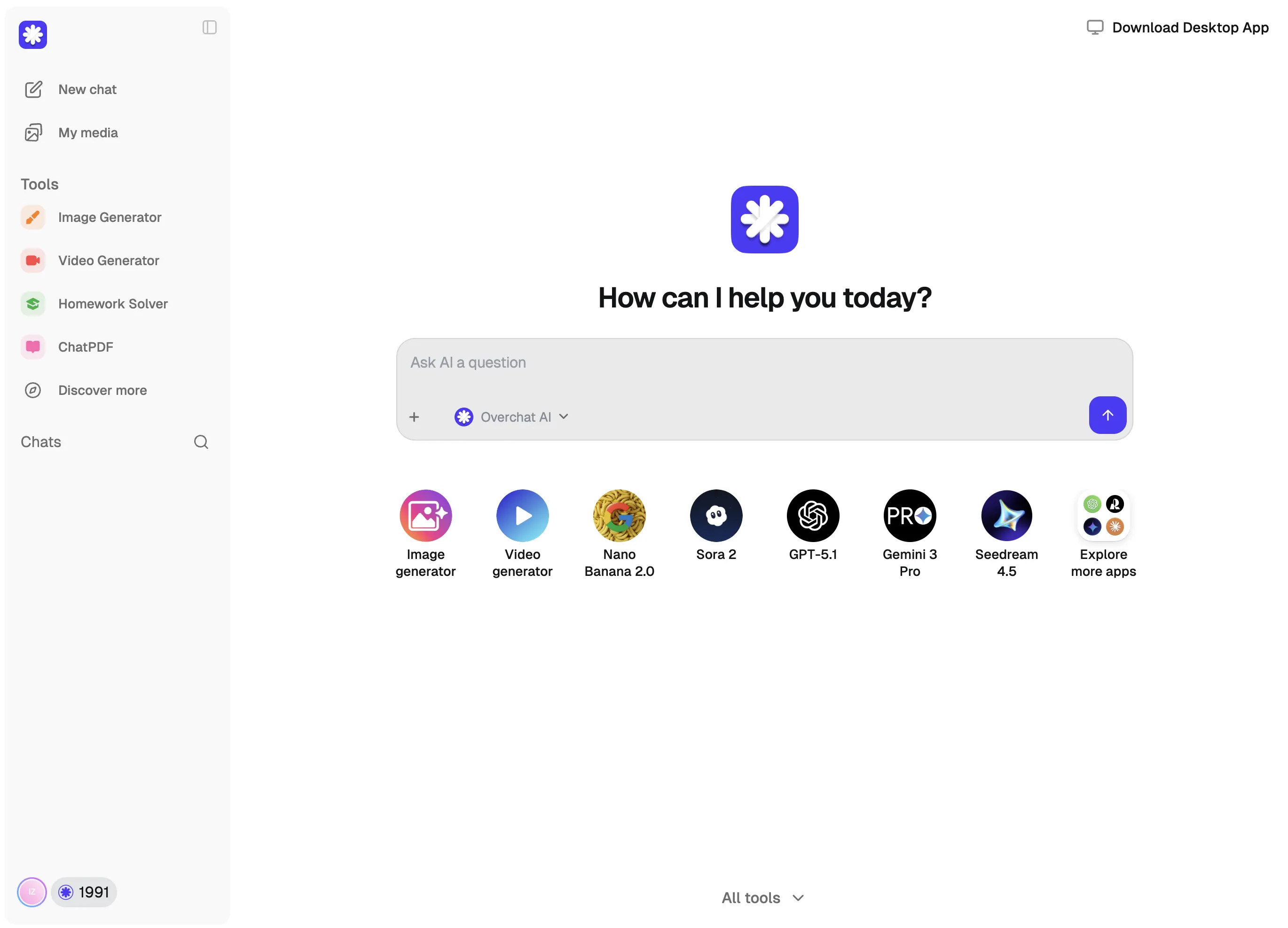
Claude Opus 4.6 is a proprietary model that was released and distributed by Anthropic through its own channels. Unlike DeepSeek models, Claude offerings aren't open source, meaning you can't install or run them locally or on Hugging Face. One of the best ways to access Claude Opus 4.6 is through Overchat AI, since you don't need a separate Anthropic account or API key.
Anthropic also offers lighter models in the Claude family: Claude Sonnet 4.5 for a balance of speed and quality, and Claude Haiku 4.5 for fast, everyday tasks. All three are available on Overchat AI.
One thing that sets Anthropic apart from other companies is its focus on safety and transparency. They design their models to be straightforward about what they know and don't know, which decreases the likelihood of hallucinations or made-up answers. This makes Claude models perfect for critical tasks, such as solving homework problems. The last thing you want is to be given a made-up answer that the model presents with confidence as real.