
Claude Opus 4.7

Anthropic's next-generation flagship model with advanced multi-step reasoning, autonomous task execution, and multi-agent coordination.

Join the waitlist — we'll email you when it's live on Overchat AI.

You're on the list

We'll email you when Claude Opus 4.7 goes live.
In the meantime, chat with dozens of AI models right now.

Create a free account

Benefits of Claude Opus 4.7

Claude Opus 4.7 is Anthropic's most advanced AI model, purpose-built for complex multi-step reasoning, long-running autonomous tasks, and seamless multi-agent coordination. It delivers a measurable leap in coding, analysis, and creative work over every previous Claude release.

The next frontier in autonomous AI reasoning

Opus 4.7 pushes past its predecessor on every major benchmark — from agentic coding and graduate-level reasoning to enterprise knowledge work in finance, legal, and research. It is designed to run tasks that take hours, not seconds, without losing coherence or accuracy along the way.

Minimalist UI illustration showing Overchat AI chat and document interface, with layered cards, message bubbles, and simplified icons in blue and white, representing AI-powered communication and content generation.
🦾

1M-token context window

Opus 4.7 retains the full 1 million token context window introduced in Opus 4.6 — but now uses it more effectively. Improved long-context retrieval means the model scores higher on multi-needle recall tasks even deep into massive documents, entire codebases, or lengthy conversation histories.

⛓️

Multi-step reasoning

Opus 4.7 excels at problems that require chaining multiple logical steps together. Whether you need to debug a complex codebase, build a multi-file feature from scratch, or work through a layered research question, the model plans ahead and maintains coherence across every stage of the task.

🤖

Multi-agent coordination

Opus 4.7 is built to orchestrate and work alongside other AI agents. It can delegate subtasks, synthesize results from parallel workstreams, and maintain a coherent plan across long-running autonomous workflows — making it the ideal backbone for agentic applications like Claude Code Routines.

About Overchat AI

Overchat AI brings you the power of the world's top AI models: ChatGPT, Claude, Gemini, Mistral, and more.

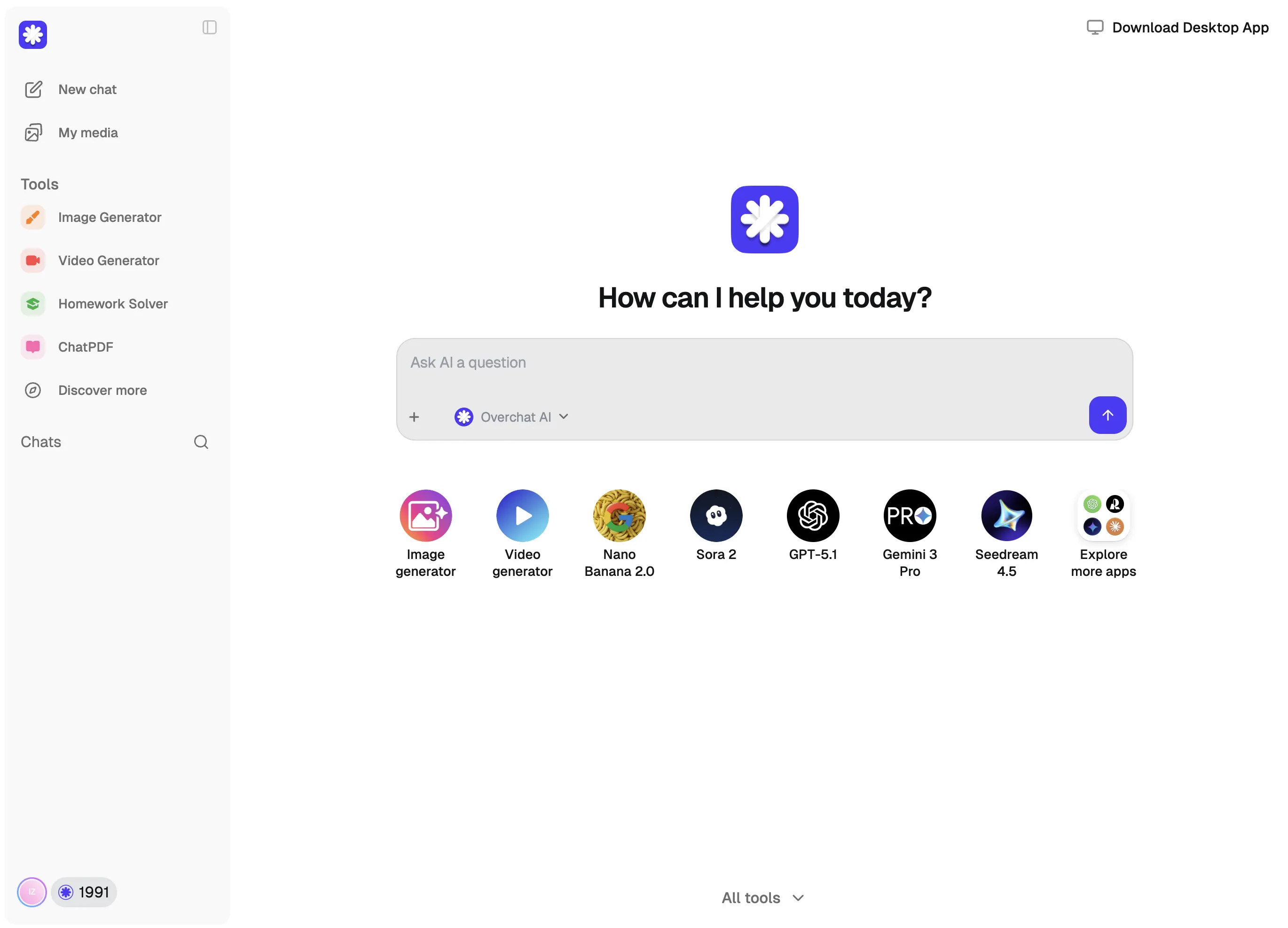
Overchat AI Interface

Best AI models available

Chat GPT Logo

GPT-5.4

OpenAI's most advanced model with exceptional reasoning, creativity, and multimodal capabilities.

Ask GPT-5.2 ↗
DeepSeek logo

DeepSeek V3.2

Advanced reasoning model designed for complex problem solving, mathematical reasoning, and programming.

Ask DeepSeek ↗
Claude logo

Claude Opus 4.6

Anthropic's flagship model excelling at reasoning, knowledge, math, and coding tasks.

Ask Claude ↗
Gemini Logo

Gemini 3 Pro

Google's most capable model with advanced multimodal understanding and generation.

Ask Gemini ↗
Grok logo

Grok 4.2

xAI's powerful model with real-time knowledge and witty, direct responses.

Ask Grok ↗
Qwen logo

Qwen 3.5

Alibaba's advanced model with strong multilingual capabilities and reasoning skills.

Ask Qwen ↗

What is Anthropic Claude Opus 4.7?

Claude Opus 4.7 is the latest flagship AI model from Anthropic, succeeding Opus 4.6 which was released in l 2025. t belongs to the Claude model family — a lineup of AI systems specifically optimized for coding, agentic workflows, and complex reasoning. Opus 4.7 represents a significant step forward in how AI handles autonomous, long-running tasks

Anthropic, the maker of Claude, was founded in 2021 by former OpenAI researchers Dario and Daniela Amodei. The company has raised over $10 billion in funding and treats AI safety as a core engineering discipline — not an afterthought. Every Claude release goes through rigorous red-teaming and alignment testing before it reaches users.
Claude Opus 4.7 Features

Autonomous long-running tasks. Unlike earlier models that work best in short back-and-forth exchanges, Opus 4.7 is engineered to sustain focus over hours-long workflows. It can plan a sequence of actions, execute them step by step, recover from errors mid-task, and deliver a finished result — all without human intervention. This makes it ideal for large refactors, end-to-end research projects, and automated deployment pipelines.

Stronger safety controls and alignment. As models become more autonomous, safety becomes more critical. Opus 4.7 ships with improved alignment measures that reduce hallucinations, tighter guardrails for agentic use cases, and better calibration — the model is more honest about what it does and doesn’t know. Anthropic’s red-teaming process for this release was its most extensive to date, covering everything from prompt injection resistance to multi-step jailbreak attempts.

Claude Opus 4.7 Release Date

April 2026. Claude Opus 4.7 release date is April 2026. Anthropic has maintained an aggressive release cadence throughout the Claude 4.x generation, shipping meaningful capability upgrades every few montths.

Launched alongside new tools. The Opus 4.7 release coincided with several major product announcements from Anthropic, such as a Routines feature that lets developers configure automated workflows triggered by schedules, APIs, or GitHub events — effectively turning Claude into a cloud-based software agent that runs even when your machine is off.

Availability. Claude Opus 4.7 is accessible through Overchat AI. On Overchat, you can start chatting with Opus 4.7 immediately after creating a free account — no API key setup required.

Claude Opus 4.7 vs Opus 4.6 vs Opus 4.5

Three generations, three leaps. Each Opus release has targeted a different bottleneck. Opus 4.5 introduced the Claude 4.x architecture and set a new standard for creative writing and natural-sounding output. Opus 4.6 expanded the context window to 1 million tokens and pushed benchmark scores to the top of the industry. Opus 4.7 takes the next logical step: it is built for autonomy, letting the model plan, execute, and self-correct across tasks that run for minutes or hours.

Compared to both Opus 4.5 and Opus 4.6, the 4.7 release delivers deeper multi-step reasoning, significantly improved autonomous task execution, and native support for multi-agent coordination that was absent in earlier versions.

Like every Claude model, Opus 4.7 is a closed-source model developed and hosted by Anthropic. You cannot download or self-host it the way you can with open-weight alternatives like DeepSeek or Llama. However, platforms like Overchat AI make access straightforward — you get Opus 4.7 alongside GPT-5.4, Gemini 3 Pro, and other frontier models in a single interface, with no API keys or separate subscriptions needed.

Opus 4.7 sits at the top of a three-tier Claude lineup. Below it, Claude Sonnet 4.5 offers a strong balance of speed and intelligence for everyday professional work, while Claude Haiku 4.5 handles fast, high-volume tasks at a fraction of the cost. All three tiers are available on Overchat AI, so you can pick the right model for each conversation.

What continues to set Anthropic apart is its commitment to safety and honesty. Opus 4.7 is better calibrated than any previous Claude model — it tells you when it is uncertain rather than fabricating a confident-sounding answer. For high-stakes work like legal research, financial analysis, or academic writing, this makes it a reliable partner you can trust with decisions that matter.

FAQ

What is Claude Opus 4.7?

Claude Opus 4.7 is Anthropic's most advanced AI model, released in April 2026 as the successor to Opus 4.6. It is optimized for multi-step reasoning, autonomous long-running tasks, and multi-agent coordination. The model retains a 1 million token context window and delivers improvements in coding, analysis, creative writing, and enterprise knowledge work across finance, legal, and research domains.

What is Claude Opus 4.7 release date?

Claude Opus 4.7 release date is April 2026. It arrived roughly two months after Claude Opus 4.6, which launched on February 4, 2026. Anthropic maintains a rapid release cadence for the Claude 4.x generation, delivering meaningful capability upgrades every few weeks rather than bundling them into a single annual release.

How to use Claude Opus 4.7?

The easiest way to use Claude Opus 4.7 is through Overchat AI. Visit overchat.ai, create a free account in seconds using Google or Apple sign-in, and select Claude Opus 4.7 from the model picker. Type your question and get a response instantly. No API key, no Anthropic subscription, and no technical setup required. Developers can also access Opus 4.7 through the Anthropic API or Claude Code.

What is the difference between Claude Opus 4.7 vs Opus 4.6?

Claude Opus 4.7 builds on the foundation of Opus 4.6 with three key improvements. First, it handles multi-step reasoning more reliably, maintaining coherence across long chains of logic. Second, it introduces multi-agent coordination, allowing it to orchestrate parallel AI workstreams. Third, it is designed for autonomous long-running tasks that take minutes or hours, not just seconds. Both models share the same 1 million token context window, but Opus 4.7 uses it more effectively with improved long-context retrieval.

Who made Claude Opus 4.7?

Claude Opus 4.7 is made by Anthropic, an AI safety company headquartered in San Francisco. Anthropic was founded in 2021 by Dario Amodei (CEO) and Daniela Amodei (President), both former members of OpenAI's research leadership. The company has raised over $10 billion in funding from investors including Google, Salesforce, and Amazon, and is one of the leading developers of frontier AI models worldwide.

Which is better, Claude Opus 4.7 vs GPT-5.5?

Claude Opus 4.7 and GPT-5.5 are both frontier AI models competing at the top of industry benchmarks. Opus 4.7 tends to excel at agentic coding, autonomous multi-step workflows, and tasks that require sustained focus over long sessions. GPT-5.5 is strong in knowledge work, computer use, and multimodal understanding. The best choice depends on your use case. On Overchat AI you can access both models side by side and compare their outputs directly.

What is Anthropic?

Anthropic is an AI safety company based in San Francisco that builds the Claude family of AI models. Founded in 2021 by Dario and Daniela Amodei, the company focuses on developing AI systems that are reliable, safe, and transparent. Anthropic's product lineup includes Claude Opus (flagship), Claude Sonnet (balanced), and Claude Haiku (fast and lightweight), as well as developer tools like Claude Code for terminal-based AI coding.

From The Blog

Overchat AI For All Platforms

Available on Web, iOS, and Android. Access your AI assistant anywhere, anytime.

Google Play Store badgeApp Store badge
Overchat AI Desktop and mobile interfaces